Blog

  • It's Summer, Baby

    Let’s try to have some fun

    When you swing in the tire swing

    make sure your socks are off. You’ve forgotten, I expect,

    the feeling of feet brushing the tops of sunflowers

    if you get there before I do, by Dick Allen

    I’m going to try to be positive about summer. I know how much you guys love it.
    Generally speaking, folks seem to really love it when the wet, chilly spring slips into the sopping hot days of summer. You feel free, untethered, perhaps? You have more time to do the things you love, maybe? The weather cooperates with your hobbies, probably? You like the longer days, I think?

    You’ll notice the prevaricating1 because I don’t really know why people love summer so much.

    Summer: Great for Thee, Sucks For Me

    Summer is a time of immense anxiety for me. I can hear you groaning, but stay with me here. I’m going somewhere good.

    Thank you for reading. Click this button and share it, please!

    Share

    Some of the stuff that I experienced in my otherwise wonderful childhood have made me inconsolably anxious when summer comes. These are the kinds of things that other people didn’t struggle with, or that didn’t cause anxiety in them. I think this is important to note because I want to be clear that I know how odd it is to be upset over a season (and one that is so universally loved, at that).

    Water, for instance. Specifically, bodies of water. I don’t like them. I was terrified of deep water for most of my early childhood. I never really reckoned with that, so as an adult, I never enjoyed water-based activities. I would rather have avoided them.2

    The old fear lingers, in the narrow spaces between anxiety, shame, and pressure from my father, who swam daily in the river as a child and didn’t understand how I couldn’t enjoy it as much as he did. I’m not sure he saw my fear as a weakness, but the shame I felt was magnified.

    Shame is a big theme in my life. My father and shame are like that meme from Predator with me in the middle. I can’t think about one without also thinking about the other.

    Anxiety is my constant companion. Anxiety is as much a part of me as anything else. This will come as no surprise to dedicated readers, as I have mentioned the word “anxiety” in 10 of the newsletters I’ve written. I probably mention it more in person.

    I have struggled mightily with the social variety of anxiety, dismissed by many (including me!) as “painfully shy,” which, while accurate, didn’t do much to help me get to the root of the problem. I know that the grown-ups in my life wanted to help me, but lacked the vocabulary. This was 1989. We barely knew what anxiety was.

    My Father Died

    I understand why people use language like “passed” or the dreaded “moved on” to describe when someone dies. The word “died” sounds so finite, brusque, sudden, unpleasant.3

    He died around 8:30pm on May 3rd, a day after my birthday. He was 80 years old, and it was 129 days after his.

    It’s hard to nail down an exact time, because the hospice experience was holistic. There were no beeping instruments measuring his vitals. There was no need for them, because his decline was obvious and inevitable.

    One minute he was breathing, the next he wasn’t. My mom and sister, who had been by his side for days, noticed that he was gone. It wasn’t dramatic. My father died like so many others do, quietly. He lived quietly, too, so it’s fitting.

    I’m not going to write about him a lot here, because there’s a longer piece about him in me. I’ll leave it with a story about the last few months of his life to illustrate my feelings without digging too deeply into them.

    Here’s That Story

    When we stopped to visit him, he never had much to say. He never, ever, had much to say, so it wasn’t unusual. One way a patient with dementia tells on themselves is a change in their conversations. The things they say don’t make the same kind of sense they did before. For somebody who doesn’t talk much, it’s harder to notice. We had to suss out his decline in other ways, and they made themselves apparent. Eventually it was impossible to ignore, and impossible for family to manage, so we could visit him in pleasant surroundings where people took care of him.

    Whenever we would visit, my siblings always gave him a hug. I found it hard to hug him sometimes. There was too much of myself in the way, and there was too much of my memories of him in the way, and they crowded at the entrance and I couldn’t get through. So I often left those visits without hugging him. The closer he got to the end, the easier the hugs came, and I was eager to close the distance between us. Too little too late, maybe.

    If there had been a person in him who could understand such things, I could have made him understand. He would have, in years past. But that’s not the guy I couldn’t hug anymore. Still there, but different. I still don’t have the right words, so I won’t rush them and make a mess of it.

    I read about some of the things peoples fathers did to them, and it was never as bad as those. But we had our own kind of difficulties, and he carried an enormous weight very quietly and where nobody else could see it, but when people carry really heavy things and don’t have the vocabulary to talk about them, it makes itself known to the people around them anyway, and it’s clumsy and hard for everybody.

    My childhood was happy, full of laughter, and I was always fed and sheltered, and loved. I have siblings and I love them, and my mom is the kindest most generous person who ever lived. But I had a complicated relationship with my dad, and that’s where I’ll leave it for now.

    The Long Staircase

    When somebody is dying, they’re walking up the stairs to a door. You can talk to them while they walk, but they never stop to chat. The last few steps are slow but certain. They go up when they’re ready. They might linger with their hand on the knob. After they go through that door, they close it behind them, and you can’t talk to them anymore. Well, you can yell through it, but they won’t answer you. Maybe they hear you, maybe not.

    Don’t worry, you’ll go through that door some day, too. If you’re lucky, you will help a few people through it first.

    Sometimes people run up the steps and dash through the door like they can’t wait to see what’s on other side. Sometimes people go through it before the rest of us are ready, and they do it when nobody’s looking, before we can stop them.

    “I’m not ready for you to go yet,” we say, to the door that slammed behind them.

    There’s a lot of metaphors for death, and I’ve written more than my share. I expect I have a few more of those in me, too.

    “‘And what would humans be without love?’”
    ‘RARE,’ said Death.”
    — Terry Pratchett

    The Summer Scaries

    Anyway, back to summer. My social anxiety and fear of the water converged at Linsly Day Camp, when I, weeping and screaming, was dragged into the pool by an upperclassman. I was 11 or so years old.

    I remember the feeling of his skin against mine as he pinned my arms to my side and heaved us both through the water of the shallow end of the pool (which I refused to leave) and into the deep end. I didn’t have that kind of intimacy with anybody, not my family, not my friends, certainly not somebody I despised.

    He let go of me and I scrambled to the wall. Even the bullies, taunting and laughing before, were stunned by my cowardice (or at least they were in my memory).

    It’s only now, with he 35 intervening years between me and that scared kid, that I realize that my early fears of intimacy could have at least partially come from that feeling, that closeness, that anger and rage and shame. What emerged in me as another panic attack or source of anxiety very well could have begun in George Sokos’s arms.

    My father hated unstructured time, and that passed to me as a deep, desperate anxiety. Summer, the season of unstructured time, was, in a word, fraught.

    While the anxiety over intimacy and closeness and romance is mostly gone, it comes back when I least expect it. Brain stuff is like that.

    This Was All 35 Years Ago

    I know, everybody has stuff that happens to them when they’re younger. Everybody has stuff that happens to them. Everybody. Nobody gets through life without Stuff Happening. Get real, Foreman. You’re not special.

    Okay so I’ve told you why I hate summer, but what does that mean?

    Think of the things you love about summer. I probably don’t like those things. I listed a few of them above, but “summer activities” also includes a whole constellation of activities, sensations and experiences that I just would rather not participate in. I don’t really need to name them all. If you associate a certain kind of activity with summer, I probably don’t like it.

    Fireworks don’t thrill me, though I admit I enjoy them when they happen. I like being close to them and feel the bangs and the smell the crackles. Fireflies are good, too. Riding bikes around my neighborhood was fun. Running through sprinklers. Playing outside. Getting a dog really stirred up and chasing each other around the back yard.

    That’s not a comprehensive list of things I enjoy about summer, but it covers some of the fundamentals.

    So you dare the plane to crash
    Redeem the miles for cash
    When it starts to dive
    And we’ll dance like cancer survivors

    Andrew Bird – Near Death Experience Experience

    Things I’ve Historically Blamed For My Summer Hibernation

    My reaction to the summer scaries is often sublimated into other areas of my life that are only tangentially related, or somewhat related. I label them as “historical” because they’re usually only somewhat accurate, and are artifacts of earlier ideas of myself. My current idea of myself is based on the most recent information I have gathered through therapy (twice a month) and a constant, ongoing internal assessment.

    – the weather (hot, humid)

    – bugs

    – sunlight

    – longer days

    I don’t like any of those things. I used to avoid them, but I’m trying to avoid them less. I always have more fun that I expected. I’m trying to remember that more often.

    Get more of this right in your very own inbox! Isn’t it lonely in there with all the coupons and forwards and stuff?

    Autumn Brings My Favorite Things

    I have no idea whether I like these things because I have always hated summer (for the reasons I noted, above), or because I like them on their own merits. As I round first base on my forty-sixth year, I don’t think it matters, because this is the life I have. My favorite things about autumn:

    – the weather (cold, crisp)

    – smells (cruncy leaves, campfires)

    – Halloween (spooky and dark and candy)

    – coziness (cuddling close to our people and our creatures)

    I love the longer nights, too, because I simply always have. I love nighttime. I’m most alive when the sun is down.

    I have loved the stars too fondly to be fearful of the night.

    – Sarah Williams4

    You might read all of this and say “so what?”

    I’m kind of ashamed that I ever felt so much shame.

    I Had a Dream

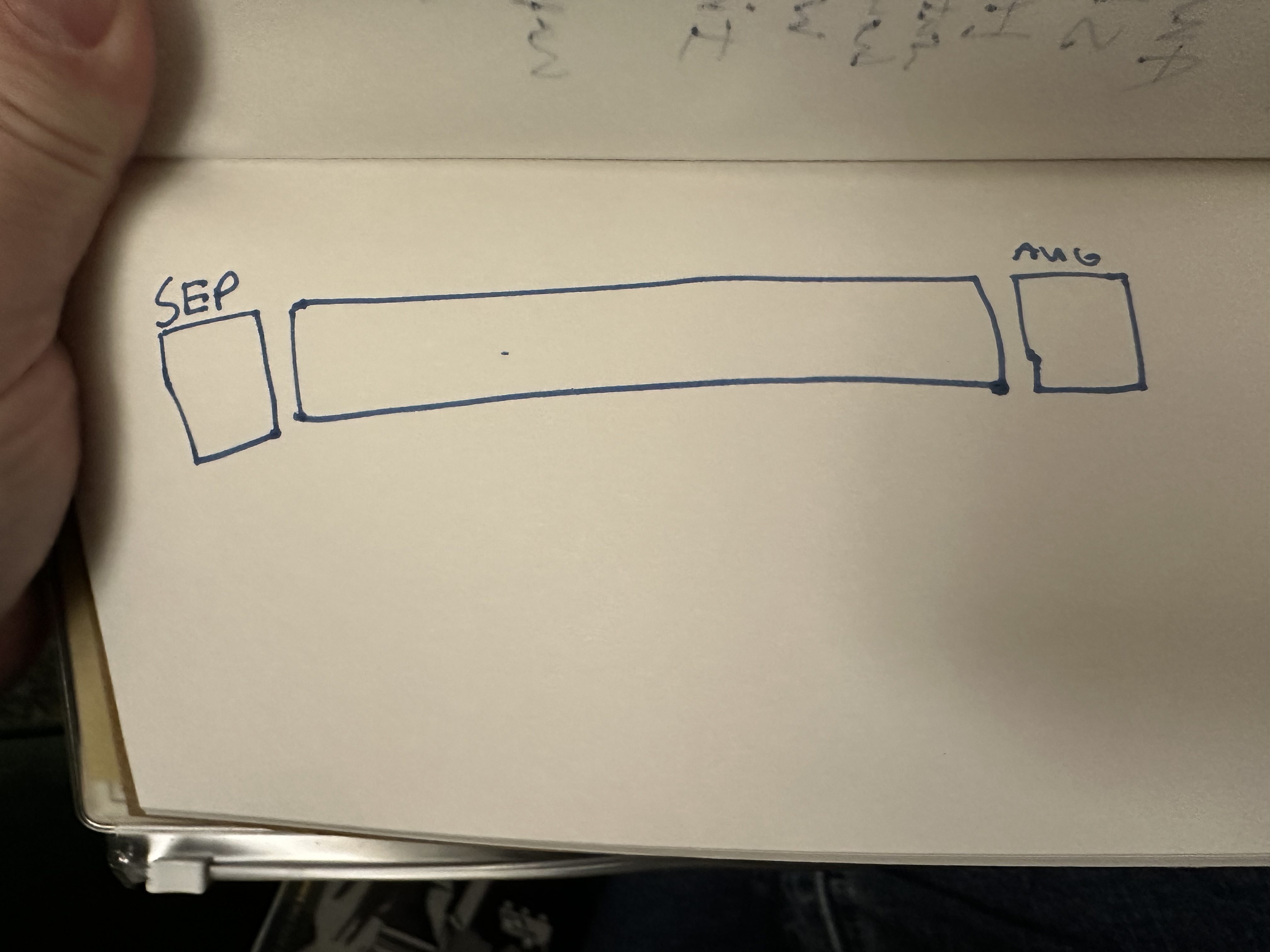
    I had a dream that I had a giant notebook. It was just a big, blank page. I drew a big “H” in one corner. I don’t know what that H means or what it stands for, if anything.

    But I know better than to ignore my dreams. They have omens and stuff in them, right?

    So I went out to the art supply store, which I love (I love the smells and sights and sounds, and the pregnant promise of so many things to make other things with), and I bought a couple of giant notebooks. I picked the one that felt right and I opened it and placed it on my favorite desk in my favorite spot in my apartment and put on my favorite headphones and used my favorite pen and drew a big H in the corner exactly like the one in my dream.

    The words came out. I wrote.

    After I was finished, probably an hour later, I felt hopeful. I have started things before. Let’s see where this goes, I thought. Good start.

    The next day, I wrote more. It didn’t stop there. It continued into the days that followed.

    I had a breakthrough. The dream foretold a recipe. When followed, the words stopped up behind the blockage came forth.

    The notebook now has hundreds of words. Maybe I’ll make them into something. It doesn’t matter.

    They didn’t just come out there, but everywhere.

    The thing about me is that I’ve never not written. Very little of it has been published, but I have been writing it nearly every day for decades. I call myself a writer not because of what I’ve published but because of what I’ve written.

    I occasionally send it out for somebody else to read and they publish it, but most of it is in notebooks and files. Nobody ever reads it. I’m going to change that, but it takes making myself uncomfortable at times when I would rather be comfortable, so I just gotta kind of make myself do it.

    I have to work now
    At things that used to be like breathing
    It Was Not Natural by Wye Oak

    Jim Shorts
    Oh children
    Poor old Jim’s white as a ghost
    He’s found the answer that we lost
    O Children by Nick Cave and the Bad Seeds

    I’m going to start writing more of these, but they’re going to be shorter and more frequent. So get ready for that. I’m trying a new feature (new to me, at least) on Substack5 that lets you create new verticals within the platform, which, to you, just means you’ll be hearing from me more. At least, you will if my plans match my actions. They don’t always.
    1

    I just realized that Substack supports footnotes, and the Pratchetterian in me is giddy

    2

    the thing about avoiding stuff you don’t like is that you miss a lot of good things, which is why I am approaching uncomfortable things more directly, these days

    3

    I’m tempted to divert into the history of words, because that’s what I do when the feelings get too big, and talk about how “passed” is more gentle and preferred in the same way that English speakers say “beef” instead of “cow” when describing the meat from the animal, and how that came from a similar desire to diffuse the language into more palatable words, but I’ll save that for a future Short Foremania, coming soon to an inbox near you.

    4

    this quote was on a print my aunt posy had, and it always makes me think of her, another person who ran up the stairs.

    5

    I’ve decided that footnotes don’t really work on the web, so I dunno if I’ll use them. I mean, are you supposed to click on the little number and go read something and then scroll back to where you think you were? Pain in the butt, if you ask me.
  • What To Do When You Don't Know What To Do

    Read to the end for a great TikTok

    I don’t have the answer to the question I posed in the title. It’s kind of a bait and switch that way, and something we never do in content marketing. One of the first rules of writing for the web is that you always answer a question you ask in titles. But that is work, and this newsletter isn’t work, even though it sure feels like it sometimes.

    That’s not true. This never feels like work, because sometimes work is enjoyable. This newsletter is a weight around my neck! But, and hear me out, that’s okay.

    I have learned that this resentment is a feature of the things we love and know we should be doing. I learned this from a book called The War of Art by Steven Pressler. I am only about halfway through it, so if it takes a weird turn into unpleasant spiritual mumbo jumbo or some other objectionable direction, I will retract my endorsement (he has already said some eyebrow-raising things about depression and anxiety, but I am choosing to overlook them). So far, so good. I like his approach.

    The Enemy is Resistance, and It Comes From Within

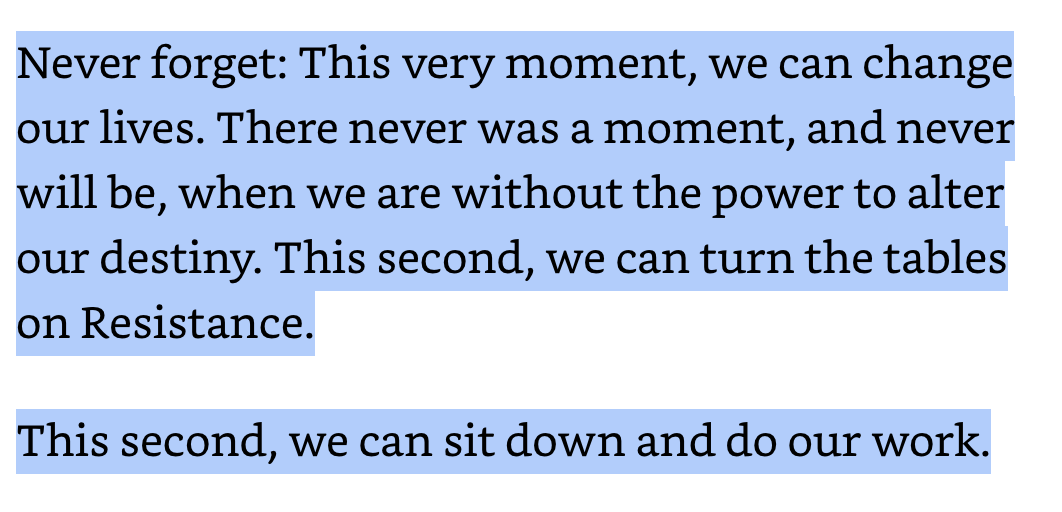
    That’s basically it: the obstacle to creating the art in our hearts is not big and scary and implacable, it is merely our own reluctance. It does not matter what form this resistance takes—we can overcome it. Here’s a highlight from the book:

    There’s a lot of power there! We are our own worst enemies, our own greatest champions. It’s all in us, baby!

    I haven’t gotten to the part where he explains how I can beat resistance, but I’m looking forward to finding out so I can start writing again.

    Oh, shit. I’m doing it now, aren’t I? Ah. Well, I’ll give him that one.

    Poetry Break

    the past is so horribly fast.

    —from I Have a Time Machine, by Brenda Shaughnessy


    How Do You Picture a Year?

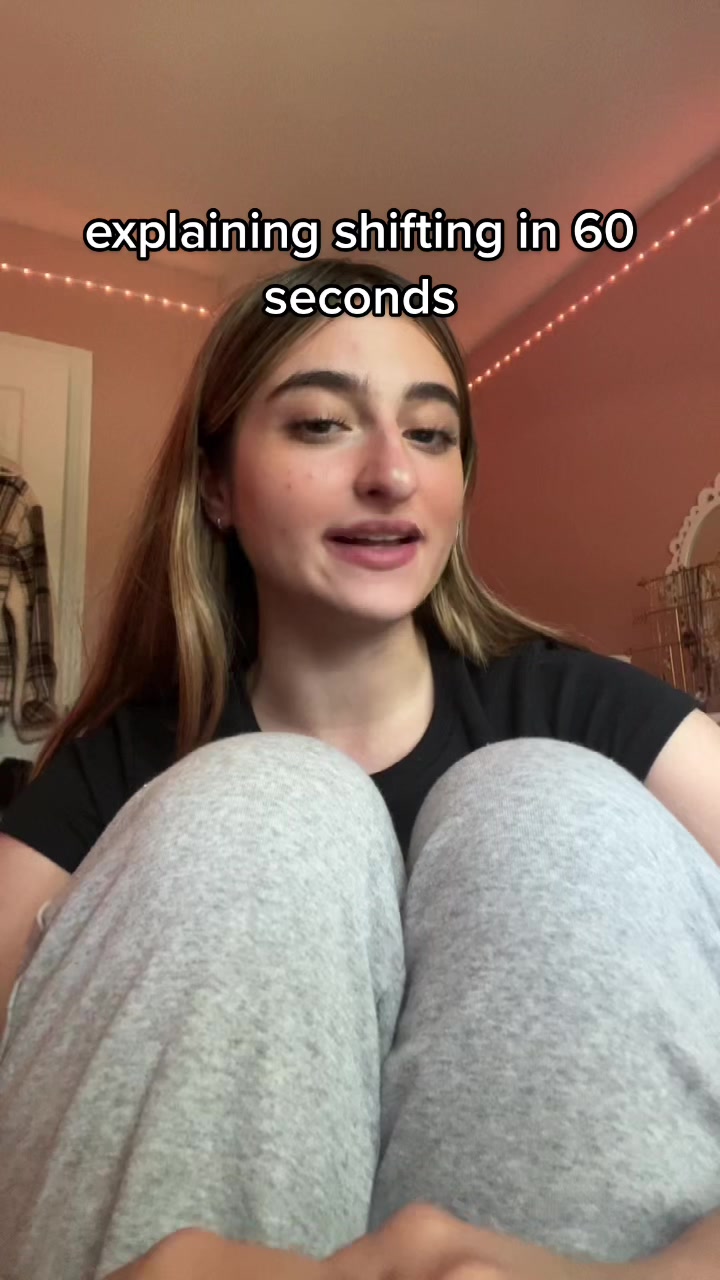
    This isn’t a Rent reference, this part is literally about how we imagine the flat segment of time called a year, divided into the 12 months we all know and love. Here’s a TikTok about it:

  • A Touch Too Much Orson

    It’s All About Me

    I went to bed the other night with joy in my heart.

    My phone, and other devices I use, have immediate and unlimited access to millions of books. Books are my favorite things in the world. I always prefer things in book form over other forms. It’s not a contest—I love movies, music, and short stories, but books are my first and greatest love.

    The joy I felt came from the vast piles of books I have not yet read. I will never run out of books.

    The Joy Didn’t Last

    I have spent the last 18 months depressed. I am in the deeps of it now, though some days are better than others. Don’t worry, I’m fine. I mean, this is part of being me. It happens. I say “I’m fine” because I’m not the kind of depressed that leads to self-harm. I always feel the need to say that, because I don’t want anybody to worry about me.

    This particular bout of depression is notable not for its intensity but for its length.

    What Kind of Depression Is It?

    Two mornings a week, I don’t have to get up for work, so I sleep. I sleep 12 hours, maybe more. I have almost no appetite, yet I’ve gained every pound back that I had lost just before it started. I am disgusted by the very sight of myself.

    This is not the largest I have ever been, but it sits differently than it did. Rather than distribute itself around my body, it now sits reliably in my abdomen. I feel more like Orson Welles than I ever have, because I resemble him more than I ever have.

    Orson was exactly the same age as me when he recorded this interview in 1960.


    He was big, brilliant, big. There are other huge differences between me and Orson, but it’s the similarities that plague me.

    Enough about that. There’s more to depression than the physical features. There is a spiritual toll, too.

    The things that brought reliable joy no longer do. I find it hard to motivate myself to do anything that doesn’t keep the lights on.

    Work is something I still am able to do, enthusiastically, as I find a great respite in the reliability and challenge of work and it is only during the work day that I feel distant from the cloud that follows me. Sidebar: I’m reminded of the many stories about David Letterman and his intense self-punishment and loathing that he endured in every hour of the day that wasn’t spent at work.

    Spurts of extra motivation go to cleaning. I’ve never been very messy, but I’ve also never been very clean. The litter box and the bathroom and the kitchen and the living room and the laundry all get cleaned regularly, and when those tasks are completed I reward myself by doing nothing. I’ve gotten very good at doing nothing.

    I work, and then nothing. I don’t do anything.

    I spend many nights nights on my phone, reading articles on Reddit and Twitter. I have friendships that go unattended, hobbies ignored, movies remain unwatched, tv shows unbinged.

    Everybody talks about how great a show is, and, rarely, I might watch a few episodes. I watched the entirety of Squid Game, but I found myself entranced by the difference between the subtitles and the dubbing (I watch everything with subtitles on, because I’m much more annoyed by loudness than I am by closed captions).

    I didn’t really even watch the show for the plot, which I found unremarkable, or the characters, which I found familiar, or the message, which I found pedantic. I watched one episode, the one with the glass bridge, in bursts. I fast forwarded through most of that episode. The drama and suspense of the game itself didn’t thrill me.

    I don’t say that to brag. I don’t think it’s a good thing to watch a popular suspense/thriller show and ignore everything except the subtitles and the dubbing.

    Breakthrough Happiness

    When people who are being treated for depression and anxiety are stable and adequately treated, the brief bouts they get of their symptoms are called “breakthrough.” I have breakthrough happiness. It comes in brief blasts. It can come from many places, or, indeed, any place. My cat is a frequent source of joy. My family. My friends. The usual suspects. But it’s elusive.

    I have felt lately that some of the fog is lifting, though I am reluctant to celebrate too early. Early signs are good that some of these struggles are becoming less struggl-y.

    I wrote a bunch of new words for my second novel, which is almost done and needs only a great opening chapter (and then a great deal of editing, which I enjoy). That was impossible only a month ago.

    I gained weight, yes, but I really just returned to the weight I was before. What is more alarming than the weight I gained was that I lost it in the first place. I was living under a different cloud then, one of anxiety. I was an anxious wreck. I didn’t eat. What was terrible for my happiness was great for my waistline. I would say it was good for my health except it most definitely was not. My current weight is bad for my health, too, and I have already made great strides to getting closer to where my body wants to be.

    My life was extremely different when it was bad, and I am still trying to fix some of the things I broke. I fear that some of them never can be fixed at all, but that’s life.

    I fully expect that the next edition of this newsletter will be about something other than me, because I’m frankly tired of myself. It took me weeks to write this newsletter, and I push publish with the relief of having finished something.

    I direct you to the most recent League of Lensgrinders, where we discuss our depression specifically in the ways it intersects our creativity. We took most of 2021 off, but my friend Evelyn Pryce and my brother Robert Long Foreman are still excited about the League. It’s far too much fun for us to stop altogether. Frankly, I don’t think I could stop it if I wanted to.

    I leave you with one of my favorite songs. I used to listen to this with my father, who is in my mind a lot lately. He’s still around, but, you know, getting old. Parents tend to do that, if you’re lucky.

  • Let's Celebrate Five Years

    Dear God, That’s a Long Time

    In October of 2016, I published my first newsletter. Since then, I have finished 1 blog post, 0 short stories and 0 novels. This newsletter is the only substantial writing I’ve done that wasn’t work-related (where I do a lot of writing).

    I can’t blame COVID-19, because that’s only been an impediment for 2 of those years. I can’t blame my brain tumor, because that didn’t happen until 2018.

    I have not been writing the newsletter instead of those other things that ostensibly amount to my raison d’être, but the evidence is clear: I have not been writing fiction. I have only been writing this.

    Sidebar: I have also been writing work-related material, as my primary job is as a content writer. The muscle gets exercise.

    I started out writing these newsletters as an exercise to keep my juices flowing. I’ve learned a lot about myself in the intervening years since I wrote the first issue, which I called a pamphlet. Here it is:

    The Collected Foremania
    Pamphlet 1: “Debate”
    ⚡️Mr. Foreman’s Amazing Electric Ephemera⚡️ “Guaranteed to take no longer to be read than takes a single cup of coffee to be drunk…
    Read more

    If this newsletter seems disconnected, that’s because I’ve been writing a lot of different things and said to myself “this is newsletter content!” and then set it aside. I collect it here tonight for you to enjoy and to clear my drafts, as it were.

    Pretending to Play

    In 8th grade or so, we were given the choice between band and gym. Terrorized by communal showers and sports I didn’t understand, I chose band. I didn’t play an instrument during middle school band, but I was there for every practice, and I took a baritone home every night and enjoyed the travel of the keys for a few minutes before putting it away. During recitals, I pretended to play. If anybody noticed that my tuba never made a noise, they didn’t say anything.

    For reasons I don’t remember, I played football in 8th grade. We never scored a touchdown. I played for an entire season and never learned what a down was. I didn’t understand any of the rules. I ran fast when they told me to, and threw my body against people I was told to throw it against. I was told to listen for audibles. I didn’t know what those were. I faked it. Nobody noticed.

    I played on offensive, defense, special teams. I was good at it. I hated every minute.

    The list of things I hated about the experience is also a list of waypoints through my 12 year old mental geography.

    A List of Things I Hated About Playing Football

    – competition

    – proving myself

    – “hitting the showers”

    – running laps

    – doing pushups

    – committing violence

    – having violence committed against me

    Sidebar: I have a pet theory that one of the reasons football persists as a national game is because of the armor you have to wear. Sorry, I meant to call them pads. Whatever you call it, it still looks like armor. Every major civilization develops warfare to the point where people wearing interlocking plates heave themselves against other people wearing similar gear.

    Like some instinctual regression toward armor, we’re drawn to both wearing it and watching people who are wearing it fight each other. Eh, it’s not much of a theory.


    It won’t be long until we grind the gears

    But carry on, we’re on to something here

    The Surprise Knock by The New Pornographers


    The Anti-Participator

    Difficult People, the late tv show about my kind of people (I don’t think you’re supposed to like the leads, played by Julie Klausner and Billy Eichner, but I do anyway) made a whole episode around the idea of the participator. Billy starts dating a guy who eagerly volunteered to be a magician’s assistant while on a date at a magic show. Billy and Julie, the annoying, obnoxious, judgmental, insensitive main characters, are shocked and dismayed to find that out about somebody who they otherwise like.

    I am not a participator.

    I have always said that there are two kinds of non-participator who doesn’t like to participate in “can I get a volunteer from the audience” stuff: the “aw-shucks-please-don’t-pick-me-ha-ha-I-actually-love-it” and ruin your day non-participators. I am better than I used to be in that I will smile and go along with it but I won’t volunteer and I won’t actually do anything. I am not a Yes And kind of guy. I’m more of a “please don’t talk to me.”

    The Outdoor Center

    I went to a private school in West Virginia for high school and junior high. In seventh or eighth grade, we were forced to spend a week at a camp with limited amenities run by hippies. It was not the best environment for 13 year olds.

    I don’t know who might have thrived there but it’s hard to imagine that five days of “roughing it” to private school kids under the watchful eye of crunchy, early-90s granola crusties had much positive impact on anybody, including the crusties.

    I had to do this at least five times that I can recall, each time for a week. This always took place during autumn, because that’s when school was, and it was always extremely muddy. There were communal showers.

    These are three of my main memories:

    1. five days of not bathing, as a teenager. The alternative, showering with other boys my age who were way farther along in adolescence than me, was unthinkable

    2. a fellow student in my grade, shirtless, muscular, walking around the “dorm” (barracks) popping his pimples at the rest of us

    3. another student, widely considered the strongest and toughest of all seventh graders (not the same one as number 2), picking his fellow classmates out of the crowd, at the cheers and encouragement of his peers, and bestowing upon them wedgies so atomic that they qualified as neutron bombs—I have memories of watching from behind a pile of firewood as he held up a poor victim’s underwear waistband, to the cheers of the rest of them

    How Not to Participate

    If there is a canonical story for non-parcipators, specifically those of us who were at the mercy of crusty granolas in the early 90s/late 80s, it’s this:

    I was likely identified early, by the crusties (also called camp counselors or whatever) as a Shy Kid who kept to himself.

    Whenever we were presented with an option to do something “fun” I always receded to the back. When participation was required, I was nowhere to be found. They were crusties but they were smart, and they clocked me early. They identified me as a Shy Kid Who Needed To Come Out of His Shell.

    They initiated a Fun Game. They had a deck of cards and anybody who drew the one single Joker card in the deck was designated the “assassin” who was supposed to privately signal the other students (I think with an “ok” sign) whereupon the victim was to theatrically “die” as if struck by God’s disfavor or whatever. This is a great idea for bringing a kid out of his shell, I think. I don’t know if it would be tried today, but back then it made sense.

    Having identified me as a Shy Kid, they arranged for me to draw the Joker and thus become the kid who would be the center of attention. They thought this would bring me out of my shell. It probably worked very well on the shy kids before me.

    They had never encountered a Foreman before.

    This Story is About a Different Foreman

    This story illustrates how we Foremans, in our larval stage especially, approach events or situations that others might find invigorating, interesting, or exciting (situations and events you might also call “new”).

    This brother started at Linsly at around the same age that the rest of us did (I have four brothers, so you will never know which one I’m referring to unless I name him, and I won’t do that here).

    Every day, this Foreman left the house and walked to school, for the first few days of his first year (this private school, with uniforms, is within walking distance of our house). He came back every day at the appropriate time, and seemed fine. Nobody suspected anything was amiss.

    A few days into this incredible first week of school at a new place with new people where he had to wear a uniform, my mother was approached by the man she had hired to do some plumbing work in a part of the basement Where Spiders Are (and where my mother resolutely refused to go). It was not the spiders that kept my mother away from the work that needed to be done but the plumbing. It was the rare home improvement task that was beyond her.

    Sidebar: my mother’s ability to do seemingly everything and anything related to running and maintaining a household is probably a big part of why the gender roles modeled for me are anything but traditional.

    The plumber came up from the basement and said “ma’am there is a young boy wearing a suit in your basement.”

    My brother, the Foreman, instead of walking to school, hid in the one place in the house he was pretty sure my mother would never look for him. He spent all day there and reemerged at the end.

    No muss, no fuss, no tantrums, no drama. He completely, imperceptibly, declined to participate. Faced with a new school in a new place, he said “No, thank you” and quietly extricated himself.

    The thing about tantrums and drama is that they bring attention right back to the person who’s throwing it. By making a big stink about how you don’t want to participate in something, you are, by default, participating in it.

    Okay, Back to Me

    I did not know that these crusties were trying to get me to participate, but it wouldn’t have mattered. No attempt to make me participate, no matter how clever, was ever going to work.

    Instead of reluctantly shrugging my shoulders and joining in the fun and realizing that I could fit in anyway, as it should have gone, I took one of my few friends aside and asked him if he wanted to be the “assassin” instead. I didn’t want it.

    If it was all secret, and I believed what they had told us — that it was completely random that I had been designated the secret center of attention, then nobody would know.

    A perfect avoidance! My friend agreed and proceeded to “assassinate” our fellow classmates instead of me. I retreated to anonymity.

    After his first few assassinations, the game was canceled. One of the counselors specifically singled my friend out, having identified him as the assassin, and said “you’re not supposed to be the assassin.”

    The game they these granola crunchies had concocted, perfectly tuned to bring a shy kid out of his shell, shattered against the power of one kid who absolutely, unequivocally refused to join. They had never before encountered an anti-participator.

    I don’t relate this to celebrate my family’s inveterate rejection of group activities. It’s not universal to every Foreman in every scenario. I’m using a shaky throughline among members of my family to make a point about myself. I don’t like being an anti-participator. I don’t think it’s a good thing. I think it’s okay, maybe even good, maybe even great, to participate in some things.

    I very strongly dislike essentialism of any kind. People are unique. Who they are, where they were born, where they grew up, etc. can inform their lives but they don’t define them. I would never assume anything about anybody for what they are, because I don’t think those things are very instructive. It makes for lazy assumptions about people.

    Having said that, when my 4 year old nephew acts like a Foreman, I feel a palpable delight. We’re inevitable.


    Anyway, next issue will have a lot less navel gazing.

  • Rise and Grind, Dirge and Dance

    It’s time for a pep talk

    One of these days, I will dance again. I have danced a few times, but I have too much shame and a poor body image and other associated inhibitors to do so as often as I am dancing in my head. I love listening to dance music, especially anything that sounds like this:


    The original title of this was “A Dirge for the Dead and Dying” but I thought that was a little too morose for what I wanted to write today, and not reflective of how I feel and also not the kind of energy I want to pop into peoples inboxes on a Sunday evening. Be warned, though, I’m going to talk about death, because it’s on my mind today, especially, of all days. 

    Today is in My Calendar as Miles Day

    Today is the seventh year since my nephew, Miles, died in a car accident. He was alone but listening to music, and it was late at night. I have put myself in that car with him many times since. I sit with him as the end comes, and he’s not alone at all. 

    My brother, his father, memorialized him with a website of our memories of Miles and the gifts he gave us. I encourage you to visit anonymousish.com today and think about that golden-haired boy with us.

    This is a Dirge Day

    In accessing the mourning part of my tapestry of available feelings, I am reminded of my friend Elicia Parkinson, who also died young, and recently, and suddenly, and without telling anyone. Of course she didn’t tell anyone, she didn’t know it was going to happen, though I suspect if she had known she wouldn’t have mentioned it. I wrote about her when it happened and this is a part of what I said: 

    Life keeps going and that person is back from where you just came from. If time is a river, they dropped anchor and waved goodbye as you went around the bend. She’s gone, now. She’s back there. 

    Everything Happens At Once

    We are blessed to experience time linearly, at a rate of sixty seconds per minute. Everything that has ever happened has happened already, and is currently happening. Imagine a long string held vertically, as if to entice a cat to play. Every event occurs along that string, stacked vertically, from the beginning of the universe to its end. Everything ends, you see, even the universe.

    I take great comfort in this. Endings are built into the fabric of everything. Order and chaos are not opposed forces, they are best friends. Order knows that chaos wins in the end, but it still stacks up the blocks that it knows chaos will one day knock over. Even though chaos claims everything eventually, order keeps us safe until we can’t be safe anymore. Endings are inevitable, but the greatest glory is for those who fight for a lost cause.

    I Won an Award 

    Our office had a lovely little superlatives survey that culminated in a lovely little awards ceremony at the company picnic. It was a nice way to show our mutual admiration for each other, and more reasons for me to feel so lucky about where I work. Here’s my award:

    Believe it or don’t, I’m known around the office for my relentless positivity. Having been faced with some challenges of my own helped me get to where I am, but it does not originate in a hospital bed. My secret is that this positivity does not come from that stuff at all but, instead, comes directly from Miles.

    Miles and I both struggled with anxiety and depression. My tattoo is a constant reminder of the light in the darkness. It was pulled straight from a page of writing Miles had done. It stuck out to me because it was on a page by itself, as if he flipped over whatever he was working on and scribbled this down. It’s a mantra. It’s a prayer. It will be with me until my own story ends.

    Well, unless my arm gets bitten off by a shark or bear or something. I suppose I could also lose it to a necronomical infection and chop it off with a chainsaw, and then replace the lost hand with the same chainsaw, but I’m not really a cabin-in-the-woods kind of guy.

    Feeling Sorry For Yourself is OK, But Don’t Let it Last

    Last night I was deep in my feelings (the bad ones), and then I happened to look at what day it was, and I instantly felt like a very large ass. I smacked myself (mentally) and told myself to pull me together.

    It is tempting to dwell on the things we don’t have. It is easy to see another person enjoying what we wish we had and feel envy. It is especially infuriating to see someone squander something we value.

    The cure for this is to make a list. It doesn’t have to be a long list. In fact, it can be just one thing that you have: rent money, a healthy body, a partner or a pet who loves you, etc. There is somebody in the world, probably not very far from you, who would love to have what you have. If you’re alive and reading this, I can name at least one thing for you.

    When you next find yourself in your feelings and feeling down about whatever it is you’re down about, remember that you are alive, right now. Rejoice! Now is all that matters, and right now, you’re right here.

    That’s something to celebrate.

  • Foremania: Brain

    To subscribe to my current newsletter, go to The Collected Foremania, hosted on Substack. Below is a recreation of my favorite newsletter (I referred to them as Pamphlets then). I have put it here because my newsletter is now hosted at Substack.

    Pamphlet 8: “Brain”

    ⚡️Mr. Foreman’s Amazing Electric Ephemera⚡️

    “Guaranteed to take no longer to be read than takes a single cup of coffee to be drunk.”


    PAMPHLET NUMBER SEVEN: BRAIN

    If you know me, you know why I picked this noun to begin my first pamphlet in almost exactly a year (the last pamphlet was distributed on July 30th, 2017). On the week of Thanksgiving in 2017, I had surgery to remove an ependymoma from my brain stem. Ependymomas are considered cancerous because they can metastasize into other areas of the brain and spinal column, though they are not usually deadly. They are extraordinarily rare in people my age. Lucky me.


    THE EXTEMPORANEUM

    a thoughtful exploration of interesting topics enhanced by personal experience and opinion; topics begin at the Theme and, like growing trees, sprout branches into unpredictable areas

    Trepanning

    I had two brain surgeries (fun fact — I keep misspelling “surgeries” as “sugaries”). Tumor surgeries are not typically emergencies, but mine was. I spent four days in the hospital leading up to my operation because the neurosurgeon only does operations on Mondays and I went to the emergency room on a day that was not a Monday. This lag time also allowed my body to absorb roughly a billion gallons of strong steroids that shrank various structures in my brain to reduce the swelling from the backed-up cerebrospinal fluid. This kind of swelling often kills people when it comes on too quickly.

    This might be one of the reasons why we occasionally find skulls up to 7,000 years old with big holes in them. The tumor on my brain stem caused a backup in the flow of fluid in my ventricles, which swelled up and got bigger, causing a condition called hydrocephaly. The pressure caused “intractable” headaches (the hospital’s word, not mine), which had become so debilitating that I nearly fell unconscious from the blinding pain. It was that incident that made me go to the emergency room the final time.

    Had I been alive in 6000 BCE instead of our current age of miracles, I would have happily submitted myself to the intrepid protodoctor who thought, correctly, that a feeling of pressure in my head would be relieved by releasing some of that pressure.

    The origin of the word “trepanning” is not, as I thought, from “tree panning,” or the practice of hacking open a hole in a tree and letting the sap run out, which is not even called that. I don’t know where that connection in my head came from, but there is a word for using words wrong.

    Malaportmanteau

    I just made that word up. “Malaportmanteau” is itself portmanteau that combines “malapropism” and “portmanteau.” A portmanteau is a word that combines two things to make up a new word (“cheeseburger,” for instance) while a malapropism is a word that is and sounds like another word, except used incorrectly and usually used humorously. Malapropisms are fertile ground for puns, so I love them and hate them.

    Trepanning is not even a portmanteau, as I thought, thus my new portmanteau, which means “a word confidently mistaken for a portmanteau.” The word “trepan,” the root of “trepanation,” is apparently derived from the greek word for boring, like this newsletter.

    That was a pun based on a homonym, which is not a malapropism. Homonyms are a variety of homophone — two words that are spelled and pronounced the same but mean two different things. Another kind of homophone is a heterograph like “to, too, and two,” or words that are spelled differently, and mean different things but sound the same. English can be confusing.

    The Most Difficult Language To Learn 

    Don’t get too excited, it’s not english, which isn’t that difficult. This, according to linguists and other professionals who know such things. I’ve only learned one language, though I took three semesters of Russian in college, in a powerful case of Past Jim overestimating how much schooling depressed and anxious Future Jim would be willing to tolerate (thank you, Lena, for passing me when I most definitely didn’t deserve it). Thus, you could say that the most difficult language for ME to learn was Russian.

    But the answer to the question is: it depends. For people who speak Standard Average English (or “unaccented” American english), the answer would be different from someone who grew up speaking Estonian, which has 14 verb cases. Bora, a language from Peru, has 350 noun genders.

    The concept of gender in languages is confusing, as noted most famously by Mark Twain, who wrote this about German, which only has three:

    Every noun has a gender, and there is no sense or system in the distribution; so the gender of each must be learned separately and by heart. There is no other way. To do this one has to have a memory like a memorandum-book. In German, a young lady has no sex, while a turnip has. Think what overwrought reverence that shows for the turnip, and what callous disrespect for the girl.

    This is true, if one thinks of gender in language as a biological sex thing, when it’s not that at all — it’s closer to the concept of genre, with nouns of similar shape or size or whatever occupying the same linguistic noun classification. Language is a living and moving thing so some languages have different classifications. My favorite is Dyirbal, which is spoken in Australia, and has a genre of nouns that includes “women, fire and dangerous things.” Brother, tell me about it.

    The answer to the question was answered by The Economist, in an article from which much of the above was derived (you didn’t think I actually knew all this, did you?), is a language used by a dwindling number of people (it was about 1000 people in 2008): Tuyuca, spoken in the Amazon. I’ll let them explain why we would have so much trouble with it:

    Tuyuca requires verb-endings on statements to show how the speaker knows something. Diga ape-wi means that “the boy played soccer (I know because I saw him)”, while diga ape-hiyi means “the boy played soccer (I assume)”. English can provide such information, but for Tuyuca that is an obligatory ending on the verb.

    The Economist article ends with a sobering reminder that one consequence of our age of technological miracles and globalization is the gradual disappearance of languages as people drift toward a common tongue. Different languages make one think in different ways, and that kind of diversity of thought is something worth saving. Language is culture, too — if we lose one, we lose the other.

    Hot Snakes

    It’s one thing to learn a language, it’s another thing to speak it. Metaphors are fraught and all too common. If I were to tell a person who’s just learning english that I wasn’t feeling well and I had “the hot snakes,” they would probably be extremely confused. That’s a bad example, because it confuses lifelong english speakers, too, as in this memorable outtakefrom Parks & Recreation, which you’ll have to watch if you want to know what hot snakes mean (if you haven’t figured it out on your own already).

    生肖

    Speaking of hot snakes, I was born in the year of the snake, according to the Chinese zodiac. Specifically, the year of the fire snake. According to one website, this is what being a snake-person means:

    In Chinese culture, the Snake is the most enigmatic animal among the twelve zodiac animals. People born in a year of the Snake are supposed to be the most intuitive.

    Snakes tend to act according to their own judgments, even while remaining the most private and reticent. They are determined to accomplish their goals and hate to fail.

    Snakes represent the symbol of wisdom. They are intelligent and wise. They are good at communication but say little. Snakes are usually regarded as great thinkers.

    Snakes are materialistic and love keeping up with the Joneses. They love to posses the best of everything, but they have no patience for shopping.

    Snake people prefer to work alone, therefore they are easily stressed. If they seem unusually stressed, it is best to allow them their own space and time to return to normal.

    In other words, it’s nonsense. The above could describe anybody. Having spent many years in school with people who were born in the same year as me, which is how the Chinese zodiac is determined, I can confidently say that lots of people don’t have all of those characteristics.

    As somebody who knows about these things will surely want me to know, the Chinese restaurant menu version of the Chinese zodiac that I’ve cited is merely scratching the surface. The true Chinese zodiac goes much deeper, going from months, to days, to hours (which are called your “secret animals,” which is awesome). It’s still meaningless.


    Recommendatae

    A selection of delights both digital and physical, curated for your enjoyment.

    James Randi on Nova

    Early Jim lived in the dark ages before the internet (people often forget that on-demand video is an extremely new phenomenon), so he derived entertainment from shows like Nova. The best episode of that show probably ever concerned The Amazing Randi, a magician turned professional skeptic. It was because of that, and Carl Sagan’s books, that I am so annoyingly skeptical. This segment, specifically, inspired the person who wrote that stuff about the Chinese zodiac you just read.


    Snowmelt by Zoë Keating

    I wrote this on Facebook so I’m just going to repost it here: Zoë Keating, whose husband died of cancer that began in his brain, released this EP recently. They were together for 16 years. She calls it “four songs from the end of a long winter.” It’s such a gift to be able to follow an artist through these emotional tribulations. The song Possible, for example, has a note of hopefulness enveloped in melancholy and I can’t stop listening to it.


    COLOPHON

    Composed on a computer, distributed to the internet via wifi at a coffee shop. The typesetting always gets extremely wonky with TinyLetter, so if parts of it look weird, it’s the platform’s fault.

  • How Dating Apps Work in 2021

    I know you’re curious

    I’m writing this for two reasons.

    1) to educate. 

    Many friends of mine have been in long term relationships (LTRs in online dating parlance) and are fascinated by how single people find other single people in 2021.

    2) to vent.

    I have come to the conclusion that nobody really enjoys online dating, and this is a way for me to complain about it. I think my complaints are weighed appropriately and not entirely baseless, but I encourage conversation!

    How Tinder Set the Fire (Sorry!)

    Tinder was invented as a normie version of Grindr. Much lamentation is made about “hookup culture.” I can’t help but read some of this consternation as coded (and maybe unintentional) homophobia, since the “hookup” we twist our pearls about was, for most of modern western history, the only way our gay brothers and sisters could be anything resembling their true selves. I won’t do the gay plight the disservice of trying to summarize it, so I will stick to what I know.

    How Grindr Revolutionized Dating

    Grindr was uniquely suited to the traditional bathhouse culture that gay men cultivated through centuries of persecution, finding mates in private underground clubs where they could be pretty sure the people they encountered were looking for the same thing they were. 

    There was no depth. Nobody was there looking for a relationship because relationships were punishable by death. They got what they could when they could. The digital version of this is a photograph and a few sentences of demographic information, maybe with some light contextualization. 

    Grindr was a way of simulating that process in a way that the traditional hetero apps simply weren’t doing. If these big dating websites weren’t outright banning same-sex relationships, they weren’t exactly endorsing them, either. Grindr allowed gay men to connect to other gay men. I doesn’t matter whether they used these connections for sex, as far as an external observer like me is concerned, because any relationship was (and in many cases still is) illegal. 

    How Tinder Ruined What Grindr Invented

    As happens so often, the hetero breeders like me saw how much fun everybody else was having and tried to replicate it. Tinder began with the premise of Grindr (photo, a couple sentences, looking for sex) but for heterosexual men and women. There were other features of Tinder that gestured toward equality between the sexes—for example, both people had to select the other before any messages could be exchanged. Other apps try to limit the ability of men to be awful (because hetero men are always awful) by using a similar mutual matching, with an additional layer of security: a man cannot message a woman until she messages first. 

    What Online Dating Looks Like Now

    If you approach these apps with a deep certainty of your own inadequacy then you will be rewarded with constant reinforcement. 

    This reinforcement does not come from anybody intentionally. Nobody is being careless with your feelings. But it feels like it.

    Online dating has become a literal version of judging a book by its cover. The old adage also included the word “don’t” but online dating proudly and enthusiastically encourages users to judge the books only by their covers. A book cover gives you basic information: a title, an image, maybe a blurb. Tinder does the same thing. 

    To continue the metaphor, you can flip the book over and see a little more information. You might get a few more photos, or a whole paragraph. Don’t expect more than that, though. You won’t get it. 

    How Tinder Works 

    You swipe. You are presented with a photo and a blurb. You can immediately swipe left (reject) or right (accept). If somebody you accept also accepts you, that is a “match” and you can move to step 2. 

    For most men, this is rare. 

    I’m not complaining! This is how it’s always been, for a long time. Men are granted vast privileges by society, and one of those is the permission from society to be horny. Men are allowed, and expected, to approach women and initiate the conversation. There are many, many exceptions to this. 

    If you ask most men on online dating (OLD, in the parlance of online dating) what their experience is like, they will tell you that it’s a lot of right-swiping (thumbs ups) with very few matches. 

    Women will largely report the opposite. A woman on OLD gets a huge number of likes and it becomes their unenviable duty to sort through the masses of suitors for one that they find desirable and/or not a creep. This criteria is different for every woman, despite what some male users of online dating like to pretend. 

    That sounds fun, like a game, you might be saying. Sure, it can be. Except

    Every App Does This Now

    Even Match.com, the old, reliable, venerable boomer of online dating, has succumbed to swipe-fever. If you use their app on your mobile phone, you’ll find the familiar interphase of Tinder, Bumble, Hinge, OkCupid and all the others. Every app does this, now. You might get more context from an app like Match or OkCupid, but the fundamental method of selecting mates is consistent across all platforms: here’s a photo, here’s a sentence they wrote about themselves, now decide. Left or right, you swipe. If you reject them, you never see them again. 

    This is the way of things in 2021. 

    Some Canards of Celibate Losers

    Forgive me for the strident tone against these men, but their complaints are offensively reductive. Even a casual perusal of message boards dedicated to such expansive concepts as “relationships” will show you that these men are hopelessly cowed by the perceived superiority of men with abs. 

    Because these men lack imagination or, apparently, empathy, they are obsessed with the men they perceive as better than them. They see tall men with muscles and flat stomachs and think that these are the reasons why those men are successful and they, short schlubs, are not successful. 

    They attribute their success to physical characteristics because that’s all they see in the women who interest them. Attractiveness is all that matters to these men, so that means only men they perceive as attractive are successful in getting the girls they also think are attractive. 

  • How Dating Apps Work in 2022

    I know you’re curious

    I’m writing this for two reasons.

    1) to educate. 

    Many friends of mine have been in long term relationships (LTRs in online dating parlance) and are fascinated by how single people find other single people in 2021.

    2) to vent.

    I have come to the conclusion that nobody really enjoys online dating, and this is a way for me to complain about it. I think my complaints are weighed appropriately and not entirely baseless, but I encourage conversation!

    How Tinder Set the Fire (Sorry!)

    Tinder was invented as a normie version of Grindr. Much lamentation is made about “hookup culture.” I can’t help but read some of this consternation as coded (and maybe unintentional) homophobia, since the “hookup” we twist our pearls about was, for most of modern western history, the only way our gay brothers and sisters could be anything resembling their true selves. I won’t do the gay plight the disservice of trying to summarize it, so I will stick to what I know.

    How Grindr Revolutionized Dating

    Grindr was uniquely suited to the traditional bathhouse culture that gay men cultivated through centuries of persecution, finding mates in private underground clubs where they could be pretty sure the people they encountered were looking for the same thing they were. 

    There was no depth. Nobody was there looking for a relationship because relationships were punishable by death. They got what they could when they could. The digital version of this is a photograph and a few sentences of demographic information, maybe with some light contextualization. 

    Grindr was a way of simulating that process in a way that the traditional hetero apps simply weren’t doing. If these big dating websites weren’t outright banning same-sex relationships, they weren’t exactly endorsing them, either. Grindr allowed gay men to connect to other gay men. I doesn’t matter whether they used these connections for sex, as far as an external observer like me is concerned, because any relationship was (and in many cases still is) illegal. 

    How Tinder Ruined What Grindr Invented

    As happens so often, the hetero breeders like me saw how much fun everybody else was having and tried to replicate it. Tinder began with the premise of Grindr (photo, a couple sentences, looking for sex) but for heterosexual men and women. There were other features of Tinder that gestured toward equality between the sexes—for example, both people had to select the other before any messages could be exchanged. Other apps try to limit the ability of men to be awful (because hetero men are always awful) by using a similar mutual matching, with an additional layer of security: a man cannot message a woman until she messages first. 

    What Online Dating Looks Like Now

    If you approach these apps with a deep certainty of your own inadequacy then you will be rewarded with constant reinforcement. 

    This reinforcement does not come from anybody intentionally. Nobody is being careless with your feelings. But it feels like it.

    Online dating has become a literal version of judging a book by its cover. The old adage also included the word “don’t” but online dating proudly and enthusiastically encourages users to judge the books only by their covers. A book cover gives you basic information: a title, an image, maybe a blurb. Tinder does the same thing. 

    To continue the metaphor, you can flip the book over and see a little more information. You might get a few more photos, or a whole paragraph. Don’t expect more than that, though. You won’t get it. 

    How Tinder Works 

    You swipe. You are presented with a photo and a blurb. You can immediately swipe left (reject) or right (accept). If somebody you accept also accepts you, that is a “match” and you can move to step 2. 

    For most men, this is rare. 

    I’m not complaining! This is how it’s always been, for a long time. Men are granted vast privileges by society, and one of those is the permission from society to be horny. Men are allowed, and expected, to approach women and initiate the conversation. There are many, many exceptions to this. 

    If you ask most men on online dating (OLD, in the parlance of online dating) what their experience is like, they will tell you that it’s a lot of right-swiping (thumbs ups) with very few matches. 

    Women will largely report the opposite. A woman on OLD gets a huge number of likes and it becomes their unenviable duty to sort through the masses of suitors for one that they find desirable and/or not a creep. This criteria is different for every woman, despite what some male users of online dating like to pretend. 

    That sounds fun, like a game, you might be saying. Sure, it can be. Except

    Every App Does This Now

    Even Match.com, the old, reliable, venerable boomer of online dating, has succumbed to swipe-fever. If you use their app on your mobile phone, you’ll find the familiar interphase of Tinder, Bumble, Hinge, OkCupid and all the others. Every app does this, now. You might get more context from an app like Match or OkCupid, but the fundamental method of selecting mates is consistent across all platforms: here’s a photo, here’s a sentence they wrote about themselves, now decide. Left or right, you swipe. If you reject them, you never see them again. 

    This is the way of things in 2021. 

    Some Canards of Celibate Losers

    Forgive me for the strident tone against these men, but their complaints are offensively reductive. Even a casual perusal of message boards dedicated to such expansive concepts as “relationships” will show you that these men are hopelessly cowed by the perceived superiority of men with abs. 

    Because these men lack imagination or, apparently, empathy, they are obsessed with the men they perceive as better than them. They see tall men with muscles and flat stomachs and think that these are the reasons why those men are successful and they, short schlubs, are not successful. 

    They attribute their success to physical characteristics because that’s all they see in the women who interest them. Attractiveness is all that matters to these men, so that means only men they perceive as attractive are successful in getting the girls they also think are attractive. 


    Rax King is a good follow on Twitter, and she’s a great writer. You can read the whole thread to get context, but I think this tweet gets to the larger point I’m making: none of this shit matters to most women. She’s agreeing with me—it’s the rare grown woman cares about abs or muscles. Some might care about height, but if a woman rejects you because of how tall you aren’t, why would you be interested in them? I would apply this logic to every rejection: why obsess over somebody who rejects you? 

    Even the word “reject” feels too harsh to describe the action. It’s much harder to reject somebody than it is to swipe left on them. You can’t engage the feelings part of yourself in the process of using these apps, because if you do, you can all too easily interpret a casual swipe in either direction as far more than it is. A swipe feels like a slap. It isn’t. 

    I think this is why so many people hate it. I say that because I think that’s why I hate it.  

    Swiping is Great (for What’s it’s Good For)!

    The swiping method is great for its original intended purpose, but because every online dating app uses it, people stop using these apps for what they’re useful for (hookups) and try to bend the paradigm into a relationship-finder. This is bad. This is a mistake. It’s also inevitable.

    The curve of dating apps in the hands of heterosexual westerners always bends toward finding meaningful relationships.

    These apps aren’t good for that for all the same reasons it’s good for finding a casual hookup. If all you care about is one night of fun, you probably don’t care about their thoughts about having children, their religious preferences, or even what they do for a living. These things all matter tremendously when you’re looking for more than that. You can get that information on some of them, but it takes a few taps. This is not a process that rewards tapping. 

    Yet still, nearly every profile I see has some version of the statement “I’m not looking for hookups.” I’d say they’re using the wrong app, but since they all do the swipe thing, I would be wrong. 

    These Apps Don’t Play to My Strengths

    I had the most fun and the most success on Craigslist. This was many years ago (14?) and I could just write weird things that would get people to email me. I had a lot of success with that approach, for obvious reasons. I define success as a lot of first dates and a few relationships that I value. This is a great example of the stupidity I was posting. I was young and foolish then, I feel old and foolish now. But still, that foolish idiot had a dating app where being a creative idiot was rewarded. 

    Complaining is Pointless

    When you’re faced with a situation you don’t like, you have two choices: participate or opt out. If you want to get a date online, you play the swipe game. That’s just how things are right now. 

    The Third Option: Wait

    Dating online now is not how it always was. People will reject the swiping thing eventually because it just isn’t conducive to the pillars of strong relationships: sharing, affection, mutual understanding, chemistry. If your only criteria for the people you date is how they look, you’ll always end up disappointed. It’s fun at first. But it doesn’t last.

    After the swiping thing runs its course, something else will replace it and we’ll have something new to complain about. 

    Wait Jim, I Thought You Weren’t Dating

    It’s true that Fiona Apple radicalized me against the myth of a forever partner, but I wrote that over a year ago and maybe I’m ready for something else. I dunno. Life is short and I am simply trying to enjoy it. 

    It’s been working for me so far. 


    Tell me I ain’t got no chance, I say “screw it” 

    Suddenly I’m not sick

    Won’t you be and bring me home

  • Cognitive Hygiene

    I’m Back, Again

    I haven’t written one of these in a while. I haven’t wanted to. This is both good and bad. Looking at the schedule, I see the last one went out on April 18, making it almost two months. 

    Hold Fast

    Everything creative in my life has stalled the last two months. This is not unusual for me in times of change. As I readjust my life to external factors, I find it takes a little time for my internals to catch up. During times of high stress, my brain closes doors, battens hatches, locks windows, ties down the furniture, and other things that prepare it for lots of shaking around and instability. Things that aren’t required for survival are set aside. 

    But Wait, What’s the Change?

    The change in my life has been mostly change to my body, at least microbiologically, in that I was fully vaccinated from COVID-19 about a month ago, when the second dose of my Moderna vaccine has replicated enough S proteins to give me sufficient protection from our generation’s hundred year plague. 

    That change in me is happening all over the country. Some people are avoiding it, but that’s between them and their anxiety, and I am not one to challenge anybody’s reluctance. If you’re looking for hectoring or defending, you’ve come to the wrong place. I suggest Twitter for that experience. 

    Miracles and Wonders

    The number of new cases in the area where I live, Allegheny County Pennsylvania, was 19 yesterday. This number has gotten smaller and smaller even as more places have opened up to maskless, breathing, disease vectors (also called “humans”). Just for the sake of contrast, the highest daily number for the county was 1074 in December. A thousand people six months ago were tested for COVID-19 in one small geographical area and that number is now 19. This is merely two years after the disease was discovered. 

    We are extremely lucky to live when we do. All evidence points to us having had a working vaccine within months of the discovery of the disease. How amazing! How thrilling! 

    Now What?

    I had a beer with other humans in an enclosed bar a few nights ago. We had masks, but we didn’t wear them. This reemergence of a social life and the freedom to, say, go to the store without wearing a mask, is as life-changing as the lockdown was. 

    It’s okay to take it slow when going back to society. It’s okay to carry a mask or even wear it whenever you feel like you want to. The lives we lost to COVID-19 are contrasted to the thousands of lives we didn’t lose to influenza. While there might be controversy about the effectiveness of masking and social distancing to preventing COVID-19 spread, there’s no question those are effective in keeping the flu from spreading.

    More Time Inside 

    I spent a lot of time inside. I don’t just mean I spent that time in my apartment, I spent it inside my head, as this newsletter can attest. I don’t think it made my life any better, but I think I know myself a little better than I did before. I spent an hour every two weeks talking to my therapist, which probably helped more. I spent a lot of time thinking about dying, but I think I understand why. If the answer is obvious to you, you’re probably right. 

    The Enchanted Loom

    I think about brains a lot. This was true long before my own brain tried to kill me, and it continues to today. I started reading a book about human intelligence that has burrowed into my mind so thoroughly that I have to read it a few pages at a time or it gets to be too much to process at once. It’s called A Thousand Brains. It’s also about AI but I haven’t gotten to that part yet. 

    We Actually Have Two Brains

    You have two brains. One is the old reptile brain and the other is the newer, fancier brain. The latter one is called the neocortex, and it covers our other brain like a catcher’s mitt on top of a baseball. The brain evolved from the inside out, layering advantageous new stuff over everything that came before it. 

    Evolution is a lot like that. We mutate, and if the mutation helps us survive and pass our genes on to the next generation, it stacks on top of all the other mutations that preceded it. Even the mutations that aren’t really helpful anymore stick around way longer than they’re needed. Our genes are not just a list of instructions for building a copy of us, they’re a map of what we were, where we lived, and what helped us survive. 

    Now I’m Going to Talk About Ghostbusters

    We can see a similar thing happen in our minds, in a way. We grow up and learn behaviors and ways of thinking about things that help us survive. I have an overactive anxiety response to certain stimuli and part of my own evolution has seen me carry some of the things that comforted me as a child into adulthood. 

    This is Also Called Nostalgia

    I will write a lot more about this in my newsletter about this kind of stuff. It’s called Middlebrow and it has a fraction of the readers that this one has, which is funny because a fraction of a small number is still a fraction, but I will keep mentioning it here because it’s just like this newsletter except I use middlebrow culture stuff to talk about stuff. 

    I saw the trailer for the new Ghostbusters movie starring Paul Rudd and a bunch of kids. It was interesting to me because Ghostbusters has become entertainment for children while the original movie, which came out in 1984, is most definitely not for children. It’s full of jokes about being a grown up. I would say it’s a science fiction horror comedy about the unnamed pre-midlife crisis many of us experience when we change careers unexpectedly. 

    But it’s also a movie about a bunch of guys using lasers to capture ghosts. They have cool technology that looks neat and familiar but it’s not futuristic. Just look at this, a ghost trap:

    It looks like something you could make in your garage. I love this aesthetic, though I don’t know what to call it. 

    Anyway, if you watch the trailer for the new Ghostbusters movie, it’s clearly made for kids. Grown ups love stuff they loved as kids. It’s tempting to think this is a recent development, because everything feels recent lately, but it isn’t. 

    Star Wars was made by George Lucas as a combination of all the stuff he loved as a kid (Flash Gordon, westerns, etc.). As my pal Matt recently showed on his twitter, the famous truck sequence from Indiana Jones is taken from something Spielberg loved as a kid, a western:


    I wrote all that stuff above to say this: we all carry stuff, some of it our own, some of it from other people. This stuff affects how we think about things, and it’s not always our fault or even in our control. The best we can hope for is to be better than we were before. 

    But it takes effort, and compassion. 

    Be compassionate to yourself. Do it for me.

  • On Come-Backs

    Breathing New Life Into Old Things

    Imagine it: a professional wrestling ring, full crowd going nuts, two wrestlers, sweaty and exhausted, shake hands over the limp body of an enemy they just defeated. Beneath them lies the body of Jim’s Fiction Writing. They are COVID and Low Self Esteem. They are bad guys. 

    Suddenly, music starts playing from the arena entrance and fireworks go off and entrance music starts playing for the old, reliable, long-lost team mate, Jim’s Unlikely Resolve. He charges into the ring and kicks the crap out of COVID and Low Self Esteem and pulls Jim’s Fiction Writing to his feet. They embrace. 

    Credits roll.

    Lights, Tunnels, Things of That Nature

    As I said to my pal Andrea recently, there’s something that happened to me when I got my first COVID vaccine. It was a Moment, one of those little events that doesn’t seem like much at first but soon reveals itself as a moment of change that leaves ripples in everything that happens after. 

    I felt as though I had written about it before and I had, in Deviations on Death

    I got the first dose of my vaccine recently, and it immediately made me glad to be alive. The ruminations on death dissipated.

    This feeling settled in even more after I got my second dose a week ago. I realized that much of my reluctance to start (or finish) big personal projects (like my fiction writing) was embedded in a deep sense of impending doom. What was the point in working on something I would never finish before the world (or I) ended? 

    It feels a little more unlikely that the world is going to end imminently, but I think even this is a less enthusiastic rebuke of COVID-19 than these vaccines deserve. The vaccines are a tremendous achievement. The technology behind them signifies a humungous upgrade in our ability to fight our ancient enemy, the microbe.

    That’s something to celebrate. No man lives or dies in vain. 

    I Mentioned Wrestling

    I used to watch professional wrestling at two major points in my life. The first was as a kid, when the WWF became so enormous. I think everybody my age watched it.

    The second was in college. Watching wrestling was something I did with my friends. It was fun to get invested in the silliness. Left to myself, I didn’t keep up with it, and my interest faded without their knowledge and enthusiasm informing and supporting my own. 

    The wrestling business is one with a sordid history. I would argue that it’s still sordid, and will remain so until it joins the 21st century. Considering the average lifespan for a professional wrestler is around 50 years, it’s in dire need of reformation.

    Just taking a look at the lexicon of wrestling terminology is a dive into its origin as a carnival act. I find the word “kayfabe” alone is incredibly useful in other contexts and I’m delighted when I can use it and the person I’m speaking to understands it. 

    Finding out that wrestling wasn’t “real” was like learning the truth about Santa Claus or how babies are made. 

    While I don’t have an active interest in wrestling anymore, I appreciate the nonsense and glee. It exists as a weird nexus of performance and athleticism that doesn’t really exist in any other form. You can be unathletic and still be a great wrestler, but being a good athlete alone isn’t enough. Great athletes can excel in their sports at the highest levels without any charisma at all, and charismatic people are all over other entertainment industries. Wrestling is a combination of both.

    Here’s Another Thing I’m Not a Fan Of

    I am not a Phish fan (which seems to be a whole identity), but there are a few songs that I like, and I like them a lot, which makes me a fan of a certain kind. This song, Sample in a Jar, came up in my algorithms somewhere, and it brought my feelings screaming back to college, which is probably what made me come up with the wrestling imagery. Anyway, I listen to this song and it paints a series of pictures in my mind. 


    College

    I often come across these paintings-made-of-feelings coupled with memories of things that never happened, and I shared one in my last newsletter. That one was wholly positive, but my memory-paintings of college are fraught. I went to college at WVU in the 90s, just as the city of Morgantown and the school’s administration were cracking down most heavily on the party school reputation. 

    That gives you an idea of what kind of time it was, but the sense memories are largely unrelated to the parties. What characterizes most of my college experience was a lot of time spent in my own head, which should come as no surprise to anybody reading this. 

    The first one is a lot like the one from last time, except the feelings aren’t entirely good. There’s an edge of anxiety around it. Like the last one, it features a room in a house as its main component, a house that I’ve never been to and only exists in my imagination. There are blankets on the walls (as decoration) and handkerchiefs over the lamps. There’s a ratty futon against the far wall. It’s an attic and smells like one, but also like incense and weed. I feel a vibrating anticipation, but it’s not the good kind of anticipation, more that I’m expecting a shoe to drop.   

    The other one is the House Party Vibe, which is captured perfectly by this Freezepop song. It’s exactly my experience at most house parties at WVU, though often the band was replaced with a DJ or just a stereo with a bunch of CDs in it. 


    That song also reminds me of one of the most intense panic attacks I’ve ever had, on the bottom floor of 123 Pleasant Street, right by the big chalkboard and blessedly close to the bathroom. It was triggered by thinking a girl was interested in me. I wouldn’t become aware that my experience was treatable for another few years.

    Anxiety was my constant companion for most of college and a lot of high school. It wasn’t until after it (around 2002) that I finally started to find a way out of it. I was desperately anxious, specifically, about intimacy and romance and everything around it. I was utterly adrift in social contexts of most kinds but the culture around male and female dynamics was particularly obscure to me. 

    I went to the biggest party school in the country for five years, spent 1/3 of the time drunk, and never once even kissed a girl. That milestone didn’t come until my mid-20s, after therapy and medication. I also didn’t learn to drive until that age, too. That probably tells you something.

    For many years, I thought I was pathetically a late bloomer. In my 40s I know that I was only a few years behind. I didn’t have the high school experience that most others had. I never had a girlfriend. I was barely aware of any of it until my freshman year at WVU, when sex was everywhere around me, and then it was extremely on my radar.

    Rather than meet those blips with joy and experimentation, I was repulsed and horrified. My reaction had nothing to do with sex or the people who were having it but with my inability to imagine how I was supposed to go from a crush to a relationship. The trajectory seemed so easy for everybody else. I didn’t know where to begin. 

    I got better, though. I learned a lot of it in my therapist’s office. That should tell you a lot, too.

    Cultural Literacy

    Here’s another one of my patented pivots back to what I was talking about before. I didn’t invent the term but I like it and use it often. I use it as a reason (you can call it an excuse if you like, and you’re not entirely wrong) to keep myself abreast of all the pop culture stuff happening that wouldn’t normally ping my radar. 

    I find a lot of value in knowing about things I’m not necessarily interested in. When I make a certain kind of reference to certain people about certain subjects (it’s different for everyone), I’m always shocked by the reaction people have to push that stuff away (“I’m glad I don’t know what you’re talking about!”).

    I don’t feel that about anything. I admit that some of the more obscure sports-related minutiae don’t do it for me, but I’m still up for learning. I find other peoples’ excitement infectious, and I really enjoy hearing somebody talk about something that interests them.

    I bring it up only because I actively have to resist my urge to excuse my enjoyment of wrestling as a younger man, as if anybody needs to justify liking what they like at any point, ever. 

    I didn’t write any fiction today but I did edit the first hundred pages of my second novel and it’s shaping up to become something I might actually be proud of. Wish me luck.

  • I Sing a Song of Solitude

    I love the passing of time

    I love being by myself. There is no place I would rather be than alone. I almost don’t even care where it is, as long as there’s nobody else around. 

    I wouldn’t mind being in London again, though. 

    Lindsay took that picture because obviously I was busy taking a picture of myself in Trafalgar Square. 

    I don’t mind having my cat around, though I am at my happiest with nobody else near me, even an animal with very few demands on my time and attention like Emmitt. Knowing that I have something to take care of, even if it’s a cat who also likes to be alone, keeps me just on the wrong edge of complete relaxation. It’s a wonder I can sleep with this animal on me. 

    Having largely worked from home this year, I would never call that alone. I have coworkers and bosses and clients and people whose jobs rely on me doing mine, which means they need a way to contact me. Even the loose tether of an email keeps me from feeling completely alone. Zoom calls and Slack channels eliminate solitude entirely. 

    The only time I am completely alone, and utterly unavailable for almost any contact of any kind, is the 30 minutes I spend every year inside an MRI machine. The only person who can communicate with me is sitting in a room nearby. They tell me when the machine is going to start its clamoring. It’s very loud. I have to remain completely still during the process, because the machine is taking a picture of the inside of my brain. I have a perfect record of never moving once during my MRI. I am extremely good at not moving.

    I know a lot of people find this experience upsetting, but not me. Like a little rabbit wedged into his little den, I am content, even with the noise.

    This subject has taken on fresh significance to me today because Tom Hanks said solitaire was a waste of time.

    When I first saw the headline, I thought it was going to be about how you shouldn’t waste time doing leisure activities that have no value beyond their entertainment value, an argument I am used to hearing. That wasn’t exactly what he was saying, as he surprises us at the end of his essay with a line about playing cribbage instead, because that was something he played with his son. 

    So he wasn’t saying “don’t waste time” he was saying “if you’re going to waste time, don’t do it alone,” which I think is also bad advice. 

    I am hostile to arguments against both leisure time and doing nothing, both of which I find extremely enriching and defend against all comers. I’ve heard it from success monsters who see all time spent not pursuing a goal to be a waste. I’ve also heard it in the Lake Woebegone old time wisdom like we get from our Tom Hankses and suchlike.  

    It’s perfectly okay to waste time and accomplish nothing completely by yourself, because being alive, simply breathing and taking up space, is a shattering rebuke of the darkness. Life is a delicate, precarious tightrope. It is valuable and precious beyond any measure. Every thought, even the tiny thud of “I’m thirsty,” is a fanatical celebration of quantum improbability. The simple, passive experience of any of our senses is a riot of chaotic yet coherent chemical reactions that, individually, are no more complex than a spark of static on your sock but collectively create symphonies in our heads. I find it impossible to consider a living, thinking, being as anything less than a precious miracle. 

    I didn’t expect to rhapsodize about the preciousness of human life but it’s all wrapped up together for me whenever people talk about wasting time, or suggesting that anything could be a waste of time. Nothing is a waste of time. In fact, if I were to ask you what you’re doing and you said “wasting time” you are probably actually doing something pretty remarkable. I would define remarkable as literally anything

    A rolling stone gathers no moss, unfortunately.

    The saying I invoke above implies that gathering moss is a bad thing. But I think a rock with moss on it is magnitudes more interesting and more beautiful than one without it. I submit that if we were rocks, moss growing on us would be something to aspire to. Look at these rocks with moss on them. Gorgeous!

    Loneliness is not Solitude

    Anyway, back to my point: I love being alone. It is perfectly possible to be alone and yet not lonely. I wrote before about the loneliest man in the world, and I’ve also written about how being alone both delights and depresses me, on alternate days. I’m not unique. I’m sure this happens to everyone.

    For every quiet evening spent with a book or just with the patterns of cracks on the ceiling of my bedroom, and the meandering tributaries and capillaries of little thoughts and diversions, I have nights where I wish that I was sharing that space with somebody else. I crave intimacy, the kind you get when you are completely yourself with someone else who is being completely themselves. 

    Being alone and being quiet are my favorite pastimes, and they don’t much lend themselves to expanding beyond the frontiers of familiar feelings. 

    I’m not worried about it. Life is a gift, even the life I spend by myself, and I won’t squander it. I fully intend to spend the rest of the night doing exactly nothing of any worth, with nobody else but my cat.

    A memory I can’t get out of my head

    I’ve had this memory in my mind for most of my life. I return to it when certain moods hit me. It’s a memory of something that never happened. It’s a collection of sensations and images that stabilized into a specific tableau. 

    A sparsely-furnished house, a bedroom, a woman in a dress standing at the window, a breeze blows past her with the smell of something floral, maybe the outside air, maybe a fragrance she’s wearing. The feeling this makes in me is peace, ease. I’ve found my place.

    It ends there. It’s like a painting made out of feelings.

    I include this sidebar purely as a counterpoint to the solitude thing. I am happy being alone, but I find myself emerging from the pandemic, however slowly, as a person who wants to share his space, if only for a moment or two.

  • Middlebrow

    Middlebrow | culture criticism by a Middle Aged Middle Child

    Oh Look, Another Project

    I saw that Twitter has a new thing, or Twitter bought a new thing, called Revue, so I decided to start a new project. This is in addition to my other projects that I’ve started and continue to iterate, none of which is my reason for living (pretend I wrote that phrase in French), which is writing fiction. Or nonfiction, or whatever I’ve decided I write. I don’t really write anything. Except this?

    Here’s a list of stuff I do:

    • The League of Lensgrinders. This is a podcast and a secret society that I get to do with my brother Rob and my friend Evelyn. 

    • The Collected Foremania. This is my newsletter. It’s personal but not gross. It’s a deep dive into the things I think are interesting. I’m not entirely sure what it is, but people seem to like it.

    • Middlebrow. Middlebrow culture from a middle-aged middle child. Marvel, Star Wars, comics, movies, fast food, that kind of thing. My intention is to write stuff about the stuff I love that is entertaining and accessible to everybody, even if you don’t share my enthusiasm. And if we can’t separate who we are from what we make, I am very middle. I’m middle-class, too, but adding that to the title seemed excessive. This is my newest baby. 

    • My Blog, which is focused on writing and stories.

    Some Things I’ve Abandoned Recently 

    • The Hazlett Histories. I really had big plans for this one. I was going to walk to the library once a week with my iPad and keyboard and research lesser-known Pittsburgh and Pittsburgh-area history and write about it. That project was as much about the process as it was about the product, as I learned when the pandemic struck and I broke up with my fiancée and found myself not living within walking distance of my favorite library in the world nor needing a break from home life that I could do once a week. My desire but mostly my ability, to create that newsletter fizzled.

    • Twitch Streaming. I was streaming as my gamer identity, alteredbeef, but I lost interest. I still do it, sporadically, but not as a thing. If you’re not streaming all the time (or at least on a regular schedule) then you won’t gather much of an audience, and without an audience, you’re just narrating whatever game you’re playing to nobody, and that makes it harder to want to do it. I don’t have to trim my nose hairs when I’m just playing games by myself, and I can zone out and not talk when it’s just me. A stream would be fun with a guaranteed audience, but it’s not fun without anybody else to do it with me and/or watch me do it. There’s no point doing something to get attention if nobody pays attention to it!

    • Plants. I always intend to Be Better This Time and not let my plants die but I never succeed. It always ends up killing them through neglect. If plants were as noisy as my cat, who I never forget about, maybe I would not be so neglectful. 

    • Exercise regimens. I always have good intentions and get a good start but then I just don’t care anymore.

    • Smoking cigarettes. Ok, that was actually 15 years ago but I’ve never had another cigarette since then and I’m still proud of it. 

    • my novel. I wrote one and it sits on my hard drive and on cloud backups and, in pieces, in the inboxes of America’s most promising agents. Most of them sent very nice rejections, and after the 30th one I simply stopped trying. I will try again, after revising it again. Until then, I will continue to work on the other novels.

    Process is Product

    That kind of sounds like a glib marketing book title or something but it’s not. As I indicated in my last Foremania newsletter, I find myself limited by my process. I can’t write my fiction because I don’t have access to the elements that make it fun for me, and if it’s not fun for me then I don’t have any reason to do it. The reward for writing fiction is the writing itself. The process is the fun, and if I can’t engage in that process, I can’t have fun, and I no longer have any reason to do it.

    Anhedonia is the Pits

    I don’t know why, but I’ve found it more and more difficult to access joy. When I first started taking Prozac, I found that joy was readily available. There was a door in my mind labeled “Joy” and whenever I opened it, rainbows and balloons would flow out.

    I credit the Prozac because I had just recently started taking it and even though I had more responsibilities then, and more stresses, I was possessed by a constant good mood. It was like putting my hand on a live wire supplying positive vibes. 

    I realize that starting a new psychiatric drug can cause an artificial elevation in mood, so maybe it was that. I also know that prozac can reduce its effectiveness (as all brain drugs can), so simply knowing that information might be having a somewhat negative influence in my conclusions. 

    My inability to access joy has translated to a consistent feeling of not being very good, emotionally. It’s like allergies except with feelings. Imagine having rhinitis except it’s your self-worth that suffers instead of your mucous membranes. I don’t know how to stop it. 

    Doctors!

    My psychiatrist is a lovely Russian man who insists I call him Dr. [first initial] despite my taking 3 semesters of Russian and flawlessly pronouncing his name in my initial call. He doesn’t know I can pronounce Russian words but I am tempted to bust out a couple of phrases I remember from college just to make him feel comfortable. He asked me three times whether I needed refills before I understood what he was saying. I don’t like comparing him to Latka from Taxi but, let’s be honest, that’s exactly how he sounds. 

    I addressed this anhedonia with him and he was more interested in finding a cause for my feelings that was not related to my antidepressant. He wasn’t the one who prescribed it, so I don’t think it’s a matter of pride. I think it’s more likely to be a case of his particular approach to psychiatry, which is refreshing. He’s not looking to antidepressants to solve everything. Maybe if I exercised more I would feel better. Sure. Maybe. We’ll see! I’m also getting bloodwork as part of his due diligence, which is also refreshing. 

    Personal is Private is Public is Popular

    I learned this early on in my blogging, which also happened around the time as my divorce, which was 1) a long time ago and 2) emotionally interesting. I wouldn’t call my divorce a particularly exciting event, especially 15 years later, but it was big news among my friend group at the time. I learned a lot then, including how much attention I could get from showing everybody everything they were curious about, which was “how is Jim dealing with his divorce?” 

    People love getting a glimpse inside someone else’s train wreck (me included!) so I’m not surprised.

    Anyway, this was just a way to get you to subscribe to my pop culture criticism newsletter/blog Middlebrow. I mean, I’ll probably get too busy with other things and stop doing it within a couple of months so it’s not like I’ll be blowing up your inbox. If you’re not interested in the stuff I like, you probably won’t like it, so I won’t feel bad if you don’t subscribe.

    While I’m Plugging Things

    We recently had a barn burner of an episode (er, meeting) of the League of Lensgrinders with my pal Amy and I really think you’d like it. You can click the link above or listen to this snippet but either way you should listen to it. Soon (this week!) I’ll be publishing our next episode on Food Writing! It’s a good one too!

  • Deviations on Death

    Alliteration is Accidental

    I wrote the following a bit ago, and I’ll get to why, but I’m including it here mostly as I left it. At the end, I’ll go back to Now. The first bit, about death, is from the Before (a month ago, or slightly more).

    I’ve been thinking about death a lot lately. I’ve been thinking about it so much I tweeted it:


    Where Does This Death Come From?

    When Rush Limbaugh died, a lot of people were talking about death, how he deserved to die, or that they’re happy that he’s dead. 

    While I intellectually understand why somebody might be happy when certain people die, and I agree that he was a garbage person, I could not participate in the glee. This is not a new insight brought to me by life’s meandering surprises, because I think my relationship with death has always been complicated. 

    This is also not an indictment of their reaction. I was never a target of Limbaugh’s awfulness, even remotely, so I have no horse in the fight. That probably influences my reaction. I was never his target, so I had the privilege of not having an opinion. Being free to not have an opinion on something is a privilege I have only recently come to understand.

    Death Was Cool?

    When I was in junior high, I would intentionally write extremely violent or gross things for vocabulary words (for example), knowing that they would get a reaction. These would invariably involve death or murder. I understand now that it was attention-seeking behavior, and not a sign of something deeper that was happening in my life or in my mind. I wasn’t a threat to anyone, I was just a middle child with crippling social anxiety who sought the most efficacious opportunities for attention. I think my teachers knew that, too, and entertained me as much as they could. 

    I reign with my left hand, I rule with my right

    I’m lord of all darkness, I’m queen of the night

    I had been caught up in thoughts of my own death. I am versed in mental health, so I know what “ideations” are and I was not thinking about killing myself. I’ve never been tempted to end it all early. Suicide has never approached my radar.

    I feel like that’s important to disclaim early in any writer writing about death, and his own death particularly, especially when he has a history of writing about his challenges with depression, cancer, etc. I’m fine. I was just thinking about death.

    Vivid Ideations

    My thoughts on my own death centered around these two scenarios. Skip this part if you might be bothered by graphic depictions.

    Scenario 1: me, in a violent accident. Blood-soaked whiskers. Red snow. It scared me. When I thought about driving somewhere, that image invaded my mind. It passed as the anxiety-induced imagery it was. It was not a portend. I have had so many anxiety-induced “glimpses” into the future, since my very youngest memories, that know none of them can be trusted. Exactly none of them have ever come true.

    Scenario 2: how my family and friends would behave in my now-empty apartment, after my death. If I were to leave here and die, I would leave behind this apartment exactly as it is. Having experienced this from the point of view of a loved one exploring the crypt-like remnants of another person’s life, frozen in time, I can easily spiral into obsessive thoughts about what my heirs would encounter. 

    “I found another power strip that wasn’t plugged into anything!”

    “How many socks did he have?”

    “Why is this here?” X 100

    “How much did he spend on this?”

    They will see the things I bought or kept in case I needed them in the future, in a future I will never see. They will comb through my diaries, and journals, and find things in them that might make them blush, or cry, or remember me fondly. They would divvy up my belongings though I think most of this stuff would go to the auction or the garbage. I could write more about the value of another person’s valuables, but I would not blame anybody for getting rid of anything they inherited that they felt no connection to. I know, from experience, that there are plenty of things remaining after a person dies that not every single thing they touched has the same weight. I value and treasure items from Posy and Miles, and they will always have more value to me than anything with a price tag on it. 

    But Not Yet

    I’m here, and taking up this space, and eating this food, but some day I’m going to leave this place and never come back, and my family will have to go through it all. What will they think? What will they find? 

    I am confident that they will find nothing scandalous. One joke among people my age is “delete my browser history before my mom sees it” but I could show my unfiltered browser history to everybody who ever mattered to me and not be even slightly concerned or embarrassed by what they would see. I am both very predictable and not scandalous.

    Dying To Live

    I read a short story about time travel. The time travel actually didn’t really matter to me as much as other parts of the story that I found far more compelling. Within this story about time travel was a secret society of magic-practitioners who discovered the confirmable existence of an unavoidable afterlife. Heaven and hell were real, and you went to one or the other when you died.

    Because they were a secret society of very nasty people, they weren’t very interested in spending an eternity in hell, so the majority of the story involved them looking for a way to obliterate themselves. 

    I don’t just mean “obliterate” in the physical way, I mean it in a wholesale spiritual way. Faced with an afterlife of suffering, they were looking for a way to make themselves cease existing, as if they had never existed.

    The complete erasure of identity or selfhood that we all fear awaits us in death was something they actively wanted, because oblivion was preferable to eternal suffering. The story is a novella I read called Salvage and Demolition.

    Not Existing 

    The sudden non-existence is frightening to us, as creatures who have existed. The fact that we may some day return to the nonexistence we experienced pre-birth is so unsettling that we have created entire belief systems around it (or, about it, at least). I don’t know if religion exists because of a fear of the obliteration of permanent death, but I wouldn’t be surprised. 

    Death is a funny thing 

    It happens to everybody. Nobody on earth has ever escaped it. It is a fundamental part of life. There are things that live a long time, but they die eventually. Everything has a lifespan, from bacteria to stars, measured in minutes or billions of years. 

    This inevitability has made it creep into every culture, in some way. The more appealing cultures, to me, embrace it and celebrate it, or at least they don’t try to hide from it. 

    The religion of my upbringing, presbyterianism, teaches that we are all destined to die, and then wake up again (?) in the afterlife we deserve determined by 1) how much we believe in Jesus and 2) whether we were good people, though 2 was not as important as 1. This thinking led to Pascal’s Wager and other inadvisable digressions.

    Consciousness is a tenuous experience

    I spent a lot of time watching documentaries about science and the brain. They were looking at human brains in an MRI, trying to find the source of consciousness, of that experience we all have, that sense of “me-ness,” that identification of who we are and how we relate to the world

    We like to think that what we experience as our day-to-day, standard average life is the one we will carry into whatever afterlife we hope lies beyond the veil. It doesn’t take long to find that the consciousness we think is so emblematic of our experience as human beings is tenuous. A shot of vodka under an overpass with friends who stole a bottle from their parents is enough to show us entirely new ways to experience the world around us. 

    When one of the scientists investigating the seat of consciousness was asked about the physical location of consciousness in the human brain, he had no satisfying answer. It wasn’t, say, in the pineal gland.

    Instead, consciousness was a flickering wave of neuroactivity that swept across the brain like a passing breeze or flashing fire. Consciousness, the essential you-ness, the experience of now, the intersection of sensory data and our current thoughts, was not a place but an event, constantly moving. The similarity between this and the revelations of Zen Buddhism are not lost on me. But this is not the place for that.

    “‎Matter flows from place to place, and momentarily comes together to be you. Some people find that thought disturbing; I find the reality thrilling.” – Richard Dawkins

    Back to Now

    As I said, I wrote the preceding at an earlier time. I was unclear about how much thoughts of my own death had interrupted the steady flicker of MY consciousness. I would stumble and trip over invisible ottomans and blame something or other for the difficulty.

    I got the first dose of my vaccine recently, an injection that everybody will hopefully soon be getting, and it immediately made me glad to be alive. The ruminations on death dissipated.

    The systems in place for getting the vaccine, like all systems, are apathetic. Systems are designed to serve the most people, harm the least, for the most net gain. Systems are not overly concerned with how anybody feels. This makes most systems hostile to human happiness, but we have no choice but to endure them.

    The thoughts of death I had before disappeared a few hours after the shot.

    I wish this relief for everyone.

    I’m hitting Publish on this one, just to get it out of my drafts. I’ve been working on it too long. It’s enough. No more ruminating tonight.


    I love this video with my whole heart. It’s an incredible 20 year anniversary of Andrew WK’s first album, I Get Wet, which mixed heavy metal vibes with party anthems and traditionally-metal-adjacent topics like death and killing and victory.

    There were a bunch of weird conspiracy theories about him that are fascinating to read and bonkers and intentionally played up (if not directly started) by Andrew himself. He maintains this mystery in interviews, mixing a weird performance art aesthetic with relentlessly positive messages of self-acceptance and a celebration of life while also somehow being completely genuine. He is a force of goodness and unapologetic cartoonish glee and I am so very happy that he has a new song out.

  • My Body, My Burden

    Finding All New Bottoms

    My original title for this was My Fraught Relationship With Pain, because I had a couple of jaunts to the emergency room and they were both pain-related. I’ll elaborate in a minute, but I ditched that title because I realized that nobody has a good relationship with pain. The title I settled on is high-school-writing-class-awful, and I know that. I’m sorry. It fits my mood too well to change it now.

    I Have a Blog Now, Again

    I used to blog. I had that blog for years. Before other internet-based methods of communicating like Twitter, I blogged a lot. It’s gone, now. I have no idea where I put it.

    I shuffled it around from domain to domain, a big shambling mess of personal anecdotes, song lyrics and Star Wars memories. The last place I remember putting it is empty. The Tumblr blog I had for almost as long is still there, for as long as Tumblr is still around. I’m annoyed at myself for not saving it but I’m also arsed if I can figure out what I was ever going to do with it.

    I’ve lost all of my writing before. Before cloud storage put everything that matters in redundant server racks accessible on a dozen devices I don’t even use anymore, we had hard drive crashes, clicks of death, power surges, and botched back-ups. I’ve lost more writing than I’ll ever publish.

    I go back and look at my Tumblr and I don’t remember writing most of those things. Part of me thinks it would be nice to have all that writing, but the larger part of me asks “why?” I don’t have an answer.

    Here’s the Blog

    My blog is at jameshazlettforeman.com which I have finally settled on as my writer name. Yes, I was influenced by my brother Robert Long Foreman, because he had the right idea from an early period in his writing career, which was to use all three of his names. I am only now realizing that this was the correct move, and you can add it to the list (ever growing) of things I have learned from my siblings in general and Rob in specific.

    When I feel more like writing it, I’ll be adding shorter form items to it. This newsletter is the delivery mechanism for longer content that tends to be more personal. The blog will have other content more focused on science fiction and fantasy and writing and things like that, but for now you can read this post about my name.

    I said I would get personal, and I will not let you down.

    There are three body-related things happening to me, or have happened recently. If you have been following my writing, you know why I might be particularly attuned to what my body does.

    This is My First Body Crisis

    Anyway, we were visited recently by the neighborhood outdoor cat, whose name I mention in this video, and whose attention Emmitt is absolutely deranged by. I did not expect Emmitt to do what he did in this video, because he has never so much as scratched me, and only hissed at me a couple of times when I cornered him in order to put him in his cat transporter.


    He bit me, I did not take it very seriously, and I was rewarded for this with a trip to the urgent care, where I was given a powerful antibiotic that handily eradicated the infection.

    This is my Second Body Crisis

    Shortly after this event, my shoulder started hurting a lot. Here’s a photo of me showing my brother in law and extremely capable physical therapist where, exactly, it was hurting. He did his best, but when I have a lot of inexplicable pain, I take myself to an emergency room.

    I went to the emergency room despite being pretty sure that the pain was from my very bad posture. I stopped sitting in the chair that was causing my pain and it stopped, which was enough to convince me that Derek was right, that it was, actually, not something to be worried about. A simple change in lifestyle was enough to eliminate the pain entirely. Mischief managed.

    This is my Third Body Crisis

    I used to think my memory problems were because of my brain surgeries, but I’m no longer so certain. I stopped drinking recreationally because I realized I was doing it as a way of marking time, which is one of the many reasons not to drink.

    I occasionally will have a drink or two after work, and I am angry at myself the next day every time, because it interrupts my sleep, which is the number one contributor to me having a more difficult day than I would have had before. Alcohol also contributes to my memory erasure. It can make things fuzzy that weren’t fuzzy before, and I don’t remember having those issues before the pandemic.

    I don’t know what causes it, but I do know that imbibing certain substances, including some of the drugs I’ve been prescribed to help mitigate my anxiety, may have been blurring my memory. When you watch a loved one go through the rigors of dementia (more than once, though they were different people), you develop a different relationship with your memory.

    Of all the unpleasant things to experience during the treatment of brain cancer, an overzealous application of general anesthesia is one of the worst. I don’t remember any of the day preceding the first surgery. My only memory is waking up after it.

    Did that first experience with general anesthesia have a permanent effect on my memory? It’s not unheard of. It doesn’t matter now. What matters is that certain chemicals can make my memory worse, and it’s best to avoid those. Also, I am less prone to bouts of Goose-ish behavior:

    I will be blogging more, but I will also be using this newsletter to talk to you, dear reader. Please read both, if that would delight you. If you derive no delight from either this newsletter or my blog, do not read them. I won’t be offended.

    Please be kind, and forgive yourself. Please give yourself permission to be flawed and human and imperfect. You’re a thermodynamic miracle. Treat yourself like one.

    But the world is so full of people, so crowded with these miracles that they become commonplace and we forget… I forget. We gaze continually at the world and it grows dull in our perceptions. Yet seen from the another’s vantage point, as if new, it may still take our breath away. Come…dry your eyes. For you are life, rarer than a quark and unpredictable beyond the dreams of Heisenberg; the clay in which the forces that shape all things leave their fingerprints most clearly.